
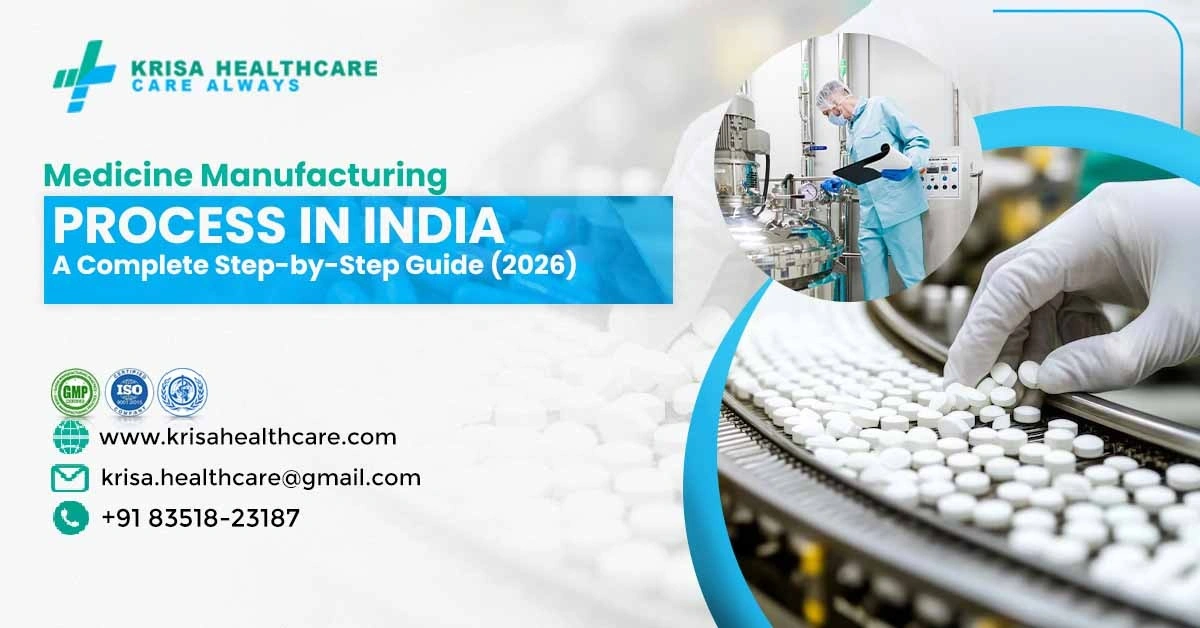
In India, the pharmaceutical sector counts among the biggest sources of quality medicines for both local use and overseas buyers. So if you’re a pharmacy startup, a brand owner, a distributor or even an entrepreneur trying to bring your own line into the market, you’ll need to grasp the Medicine manufacturing process in India in a real, practical way. Because each part of the journey, from early product planning and raw material sourcing to quality checks, labelling, and logistics, has to follow tough quality rules and also regulatory expectations. And honestly, trying to manage all of that alone can feel messy, slow, or just risky. Working with a reliable pharmaceutical manufacturer like Krisa Healthcare can smooth the overall process a bit, while keeping product consistency, regulatory alignment, and on-time shipment under control.
What is the medicine manufacturing process?
The medicine manufacturing process is basically a deliberate way of producing pharmaceutical goods so they actually satisfy set quality, safety, and efficacy targets. Each phase follows written procedures, routine quality checks, and regulatory expectations, so the final medicines stay fit for patients, and not just “made somewhere”.
What do you understand about the Step-by-Step Medicine Manufacturing Process in India?
In India, the pharmaceutical manufacturing process is carried out with strict quality standards, so medicines are safe, effective and also aligned with legal requirements. In a real Pharmaceutical manufacturing company in India, the whole flow from procuring raw materials to dispatching the finished products is monitored carefully, as per Good Manufacturing Practices (GMP) and Schedule M, if applicable. And if you’re a pharma entrepreneur, brand owner or a healthcare company, then this kind of understanding can help you choose the right contract manufacturer, while keeping product quality stable and consistent.
1. Product Research & Formulation Development
It all starts with research and development (R&D), where different teams craft a product around clinical needs, stability, therapeutic performance, and also what the market actually wants. In general, the process includes several main tasks, like
- selecting active pharmaceutical ingredients (APIs)
- choosing the right excipients
- preparing trial formulations
- doing compatibility studies
- running stability tests
2. Purchase of Raw Materials
Raw materials are usually obtained from trusted vendors, and before they’re used in manufacturing, they’re put through rigorous quality screening. This step typically includes, for example,
- APIs
- Excipients in Pharmaceuticals
- Packing materials
- Cartons and labels
The identity, purity, potency and conformance with specified specifications are determined for each substance.
3. Raw Material Quality Control Testing
All raw materials are tested by the Quality Control (QC) department before manufacture. Thus, some commonly performed tests include:
- Assay Identity testing
- Moisture content
- Microbiological analysis
- Analysis of impurities
- Production releases only material that is authorised.
4. Manufacture and Processing
In a genuine Tablet manufacturing company in India
The dosage form especially influences the production process.
- Tablets
- Administering, Combining (maybe more than once if needed)
- Granulations
- Milling, Compression, Drying
- Film coating ( if needed ) Capsules
- Mixing of the filler— for capsules
- Finishing, Inspection
- Syrups: Preparation of solutions, Filtration, Mixing, Filling
5. Quality Checks in Production
Quality is monitored at all times during production, so that uniformity stays there.
- Typical in-process checks are kinda like this:
- Variation in tablet weight
- Testing hardness
- Time to break up
- Dissolution testing, pH testing
- Fill level check
- Visual examination
Hence, these checks reduce production errors and help keep consistency across batches.
6. Packing
Once manufactured successfully, items are packaged to protect against moisture, light, contamination and physical damage. Thus, Packaging may consist of the following:
- Blister packs
- Strip packs
- Bottles and Tubes
- Ampoules, vial boxes, package inserts
- Labels are checked for accuracy before shipment.
7. Testing of Final Product Quality
The completed drugs are carefully tested in the laboratory before being released. Hence, there are some Tests usually include:
- Assay, Dissolution, Uniformity Tests
- Sterility (for sterile products)
- Microbial limitations
- Verification of stability
Common Challenges in Pharmaceutical Manufacturing Process
Any well-established and customer-oriented Medicine production company in India faces operational issues during pharmaceutical manufacture.
1. Maintaining Consistent Product Quality
Solution: The first thing you can do is select manufacturers with strong quality management systems, checked and verified processes, plus experienced manufacturing teams.
2. Regulatory Compliance
Solution: Partner with manufacturers that follow Indian pharmaceutical regulations, and make sure every production record and the paperwork is kept up to date and properly maintained
3. Production Delays
Solution: Select a manufacturing partner with solid production planning, plus dependable supply chain management, so the whole process doesn’t end up stuck or stalling out
4. Raw Material Quality Issues
Solution: this one is to Source materials from qualified vendors and run thorough inbound quality inspections
5. Packaging and Labelling Errors
Solution: Put in place several inspection phases before final shipping to reduce labelling and packaging anomalies
Why is Quality Control Important in Pharmaceutical Manufacturing?
In the medicine manufacturing process in India, quality control helps safeguard patients and also increases the company’s trust level. So there are several key benefits, like:
- Consistent product quality
- Better patient safety
- Regulatory Compliance
- Fewer manufacturing defects
- Higher client confidence
- Stronger brand reputation
- Reduced risk of product recalls.
How to Choose the Best Medicine Production Company in India?
Before choosing a manufacturing partner, have a look at, and kinda think through, several things first:
- Manufacturing infrastructure
- Quality management systems
- Product Portfolio
- Production Capacity
- Timely delivery performance
- Regulatory Compliance
- Technical expertise
- Customer Support
- Transparent business practices, no hidden stuff.
In short, choosing the proper partner lowers operational risks while also pushing long-term business success, which is kinda the whole point.
Why choose Krisa Healthcare for medicine manufacturing?
If you are looking to invest in a reliable medicine manufacturing process in India, it’s important to keep an eye on several things. Dependability, quality, plus operational expertise. When you’re trying to invest in dependable medicine manufacturing in India, those areas can’t really be skipped. Krisa Healthcare provides complete manufacturing solutions for pharmaceutical firms, startups, and healthcare entrepreneurs.
Benefits of working with Krisa Healthcare
- Advanced pharmaceutical manufacturing infrastructure, very hands-on
- A wide range of pills, capsules, syrups, injections, ointments and other dosage forms
- Quality-driven manufacturing practices, not “almost” quality
- Modern manufacturing and quality testing facilities
- Reliable production planning and timely delivery
- Custom and third-party manufacturing options too
- Strong packaging and labelling support
- Dedicated client assistance throughout the entire manufacturing process
- Transparent corporate methods and a long-term partnership strategy
So, Krisa Healthcare, centred on quality, efficiency, and customer satisfaction, helps businesses move safe, effective, high-quality pharmaceutical products to market, without the usual headaches.
Conclusion
The Medicine manufacturing process in India involves far more than simply producing pills or capsules; it really includes meticulous planning, quality assurance, regulatory compliance, and streamlined supply chain management across every stage. For any company that wants to launch or broaden their pharmaceutical product line, working with a seasoned manufacturer can significantly reduce day-to-day operational complexity. Beyond that, Krisa Healthcare blends modern manufacturing infrastructure with quality-first procedures and dependable business support. In other words, we continually help pharmaceutical brands deliver safe, effective, and truly high-quality medications with confidence.
Frequently Asked Questions (FAQ)
Q1. What is the very first stage in the medical manufacturing process?
Ans: The Medicine manufacturing process in India usually starts with product research, then formulation development and some strategic planning, based on therapeutic goals and market needs, not just one thing.
Q2. Why is quality testing needed during manufacturing?
Ans: Quality testing is there because it assures raw materials, in-process batches, and the final pharmaceuticals all meet the required safety, quality, and consistency levels.
Q3. How much time does the pharmaceutical production procedure take?
Ans: It really depends on the product type, the scale of production, how quality testing goes, plus packaging and all the regulatory documentation that needs to be prepared.
Q4. What kind of documentation is required in pharmaceutical manufacturing?
Ans: Manufacturers keep a whole lot of records like batch manufacturing records, quality control reports, standard operating procedures and also product specifications, so overall compliance and traceability stay in place. Sometimes they also hold supporting documents for audits and verification purposes.
Q5. Why choose Krisa Healthcare for pharmaceutical manufacturing?
Ans: Krisa Healthcare is a well-regarded pharmaceutical manufacturing company in India for a few reasons: it has strong manufacturing capabilities, a diverse product portfolio, solid quality standards, fairly consistent delivery schedules and dedicated client support.


